The AI Black Box Problem

After reading this article, you will be able to describe the common barriers TO AI adoption and the 4 hallmarks of algorithm transparency
SUMMARY:
Clinicians and patients must have confidence that AI models function properly and trust the decisions provided.
Even with algorithm performance, significant barriers are impacting clinical adoption.
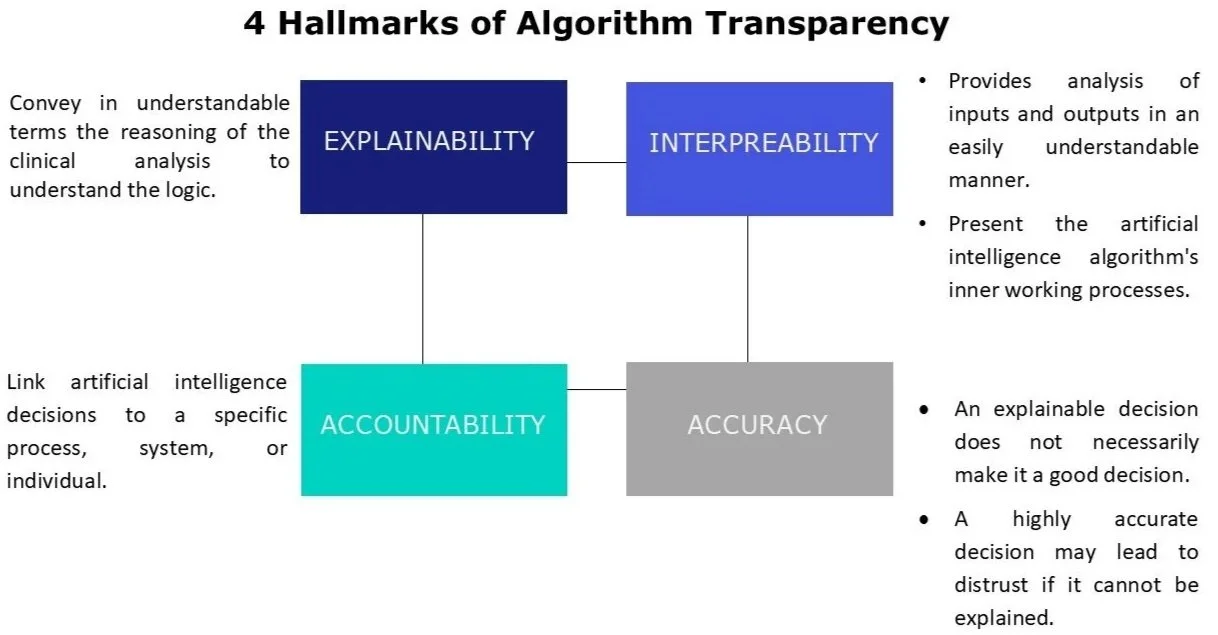
The 4 hallmarks of algorithm transparency are:
Explainability
Interpretability
Accountability
Accuracy
BACKGROUND
Integration of AI tools into clinical practice is successful only 15–25% of the time, with approximately 60% of projects failing to progress beyond pilot testing.
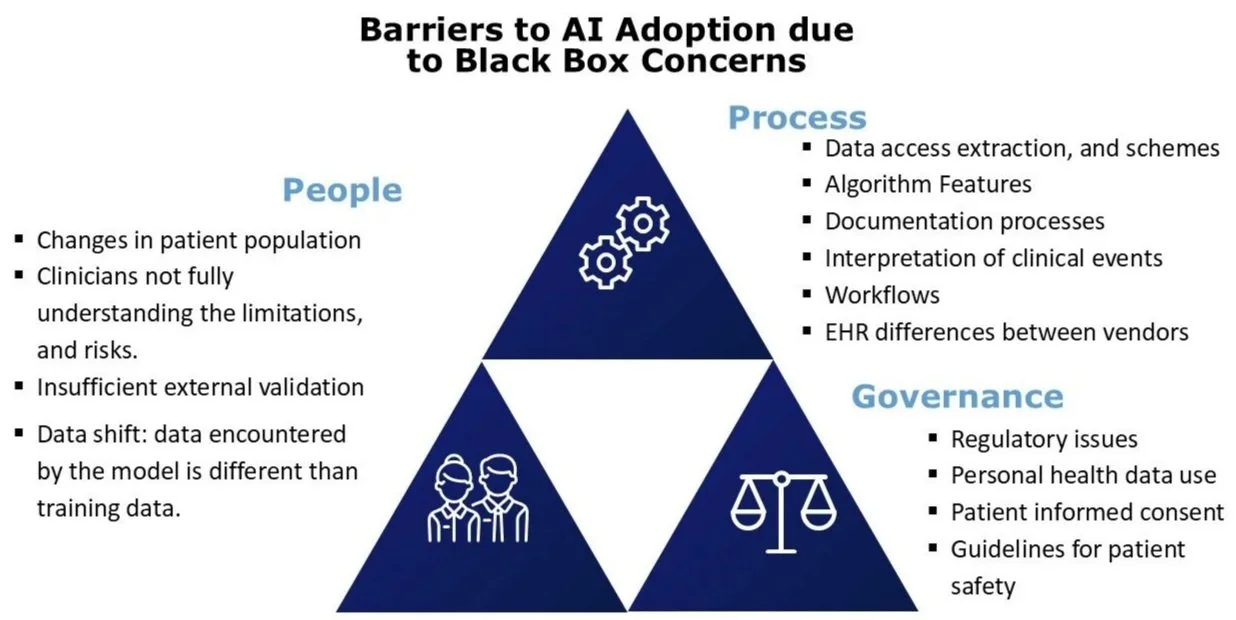
Barriers to AI adoption include:
People:
Changes in patient populations (testing well in 1 group, but not well in another)
Clinicians are expected to act on model output without fully understanding the model’s limitations, risks, and validation.
Current external validation is insufficient to ensure safe and effective clinical use
Data shift: the data encountered by the model is different than the data it was trained on.
Process:
Data access extraction, and schemes
Features and their definition
Documentation processes
Interpretation of clinical events, especially across institutions
Workflows
EHR differences between vendors
Governance
Regulatory issues
Personal health data use
Patient informed consent
Guidelines for patient safety
4 HALLMARKS OF ALGORITHM TRANSPARENCY
Explainability: Convey, in understandable terms, the reasoning behind the clinical analysis to clarify the logic.
Interpretability: Provides analysis of inputs and outputs in an easily understandable manner. Present the artificial intelligence algorithm's inner working processes.
Accountability: Links artificial intelligence decisions to a specific process, system, or individual.
Accuracy: An explainable decision does not necessarily make it a good decision.
A highly accurate decision may lead to distrust if it cannot be explained.
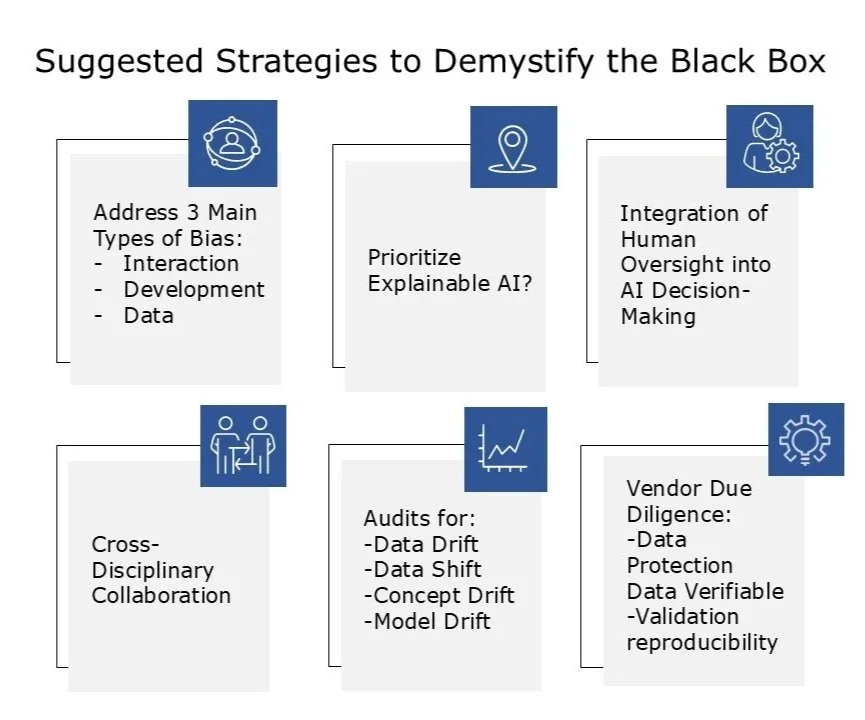
DEMYSTIFY THE BLACK BOX - SUGGESTED STRATEGIES
Address the 3 main types of Bias:
Interaction Bias: Training end users on how the algorithm is used.
Development Bias: Designing the AI to avoid incomplete data and train users.
Data Bias: Training the data on various groups of patients.
Prioritize explainable AI
Stress the importance of evidence-based clinical decision-making with transparency and interpretability of all AI decisions.
Integration of human oversight into AI decisions
AI does not replace human involvement
As the clinical decision risk increases, human oversight and involvement should increase.
Obtain patient-informed consent on AI use.
Foster Cross-Disciplinary Collaboration - Enhances fair clinical outcomes.
Regularly scheduled AI Performance Audits to determine if decision patterns change over time.
Data Drift – The data being fed into the AI changes over time, causing different decisions than it did previously.
Data Shift – Changes in the distribution or characteristics of input data alter model outputs and decisions.
Concept Drift – The relationship between the input data and the correct outcome changes over time, causing decision patterns to change.
Model Drift – The overall performance or behavior of an AI model changes over time due to changes in data, environment, or usage.
Vendor Due Diligence: Ensure compliance with regulatory and industry standards.
Data protection during access, computation, and outputs
Data auditable and verifiable
Validation reproducibility over time, datasets, and settings
CONCLUSIONS:
Building clinician and patient trust is crucial with increasing Ais role in healthcare.
Algorithmic transparency of clinical decision recommendations and bias identification enhances trust
To succeed, healthcare systems must integrate effective strategies to prioritize explainable AI algorithms and conduct regular audits.