Scaling AI Tools Across an Enterprise Health System

After reading this article, you will be able to describe the risks of AI scaling from a pilot site to an enterprise health system deployment and how to avoid them for success.
SUMMARY:
Scaling is an important step in determining the success or failure of an AI tool.
Scaling from a single pilot to an enterprise program rarely translates seamlessly
Strategic planning is needed to achieve a sustained, safe, effective, and consistent outcome.
CONSIDERATIONS
Scaling ≠ Copy and Paste
Scaling is the deployment of new tools for enterprise planning and design, coupled with local adoption.
Implementing an enterprise AI solution is NOT about the technology but rather an overarching strategy of integration and trust.
REQUIREMENTS FOR SCALING AI TOOLS
Treating the scaling of AI tools as an organizational strategy
Proven evidence of safety and clinical impact
Developed a framework to improve consistently:
Operational efficiency
Patient outcomes
Evidence-driven innovation
Improve clinician workflow
Clinical Champion
Continuous monitoring
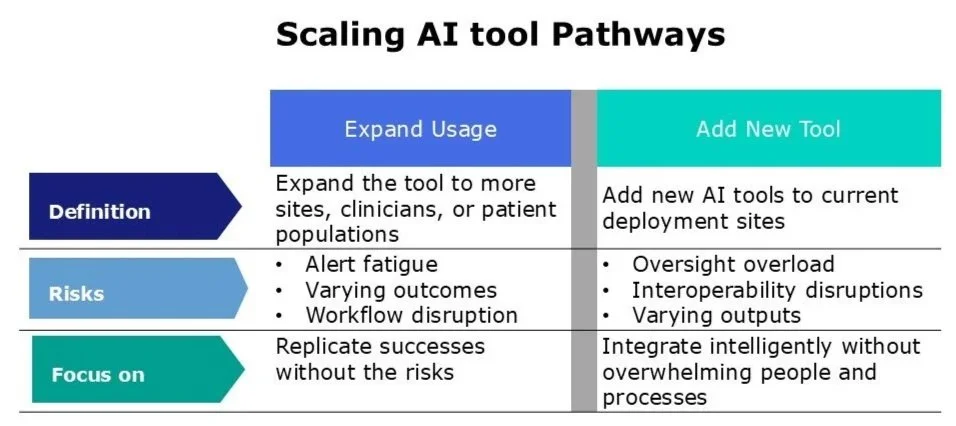
SCALING PATHWAYS
There are 2 forms of AI tool scaling:
Expand the usage of an already developed tool
Expand the number of AI tools to current sites
Each pathway has a different goal and set of risks
SUCCESSFUL SCALING STRATEGY
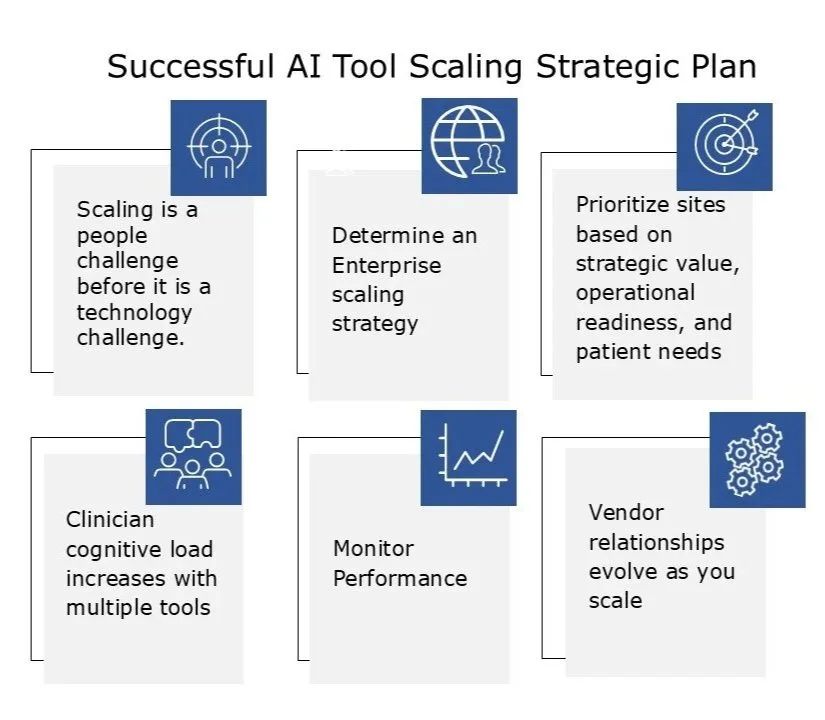
Scaling is a people challenge before it is a technology challenge.
Constant training on local issues
Optimal use of clinical champions as peer educators and problem solvers.
Determine an Enterprise scaling strategy
Systemwide AI tool needs
Learn the successes from pilots
Correct what did not work
Validate interoperability early
Introduce AI tools deliberately
Determine interoperability early
Sequence deployment intelligently
Prioritize sites based on strategic value, operational readiness, and patient needs
Clinician cognitive load increases with multiple tools
Establish a detailed training plan with integration and escalation points.
Monitor Performance
Review and re-establish parameters at each site
Compare pilot results at each site
Develop an easy-to-use monitoring dashboard
Detect inconsistencies early
Track over time
Share findings
Update training and processes as needed
Vendor relationships evolve as you scale
As the number of vendors increases, oversight needs must scale too.
CONCLUSIONS:
Successful scaling of an AI tool is fraught with risks. An enterprise strategic plan is needed for the innovative system to be successful.
Success will not translate to outcomes automatically
Implementation is NOT the goal; rather, sustained, effective, and consistent performance is the desired outcome
When done properly, you accelerate your organization into a leadership position.
Adequate AI tool scaling is an important step in the success or failure of a project.
Scaling is not copy-and-paste from the pilot site to each clinical site.
Scaling of AI tools requires an organizational strategy and is fraught with risks.
A successful scaling strategy is presented.
Let’s have a brief chat to discuss your unique situation